Lone Star Analysis Ltd. Appoints Katherine Simmonds as UK Chief of Staff

Lone Star Analysis Ltd., a trusted provider of leading-edge predictive and prescriptive analytics and Evolved AI, is excited to announce the appointment of Katherine Simmonds as the company’s new UK Chief of Staff. Simmonds brings experience from her distinguished career in both military and civilian roles, making her a valuable addition to Lone Star’s leadership team.

Simmonds’ hire aligns with the Lone Star’s recent expansion in the UK market. Back in February, the company opened a new headquarters in Lincoln to better serve customers throughout the UK, the Commonwealth, Europe, and the Middle East.

“I am honored to join Lone Star and be part of such an innovative and forward-thinking company,” said Katherine Simmonds. “I am excited to contribute to our mission of delivering cutting-edge analytics and AI solutions, and I look forward to collaborating with the talented team at Lone Star to drive operational excellence and support our clients’ success.”

Simmonds began her career as a Royal Air Force Communications Engineering Officer, showing exceptional organizational skills and dedication, managing teams and large projects with finesse. Her ability to oversee large-scale operations and budgets, along with her expertise in stakeholder management, positions her as a key asset for Lone Star.

Throughout her career, Simmonds has managed numerous equipment programmes, controlled substantial budgets, facilitated information sharing and improved communication with external agencies. Her technical skills include IT support, database management and creating user-friendly electronic data storage systems, making her a versatile leader.

Simmonds is also notable for her strong communication and administration skills. Moving into the hospitality sector after the Royal Air Force she has coordinated high-profile events and business conferences. Her extensive experience in team management, coupled with strong interpersonal skills and attention to detail will contribute to a more efficient and high-performing team.

“We’re excited to bring Katherine on board as we expand our footprint in the UK,” said Robin Adlam, Managing Director of Lone Star Analysis Ltd. “Her extensive experience in both military and civilian roles, along with her exceptional management and organizational skills, make her a perfect fit for our growing team. Katherine’s expertise will be instrumental in driving our operational excellence and supporting our strategic goals.”

Web Manuals wins second South American carrier in 2024, SKY Airline

Web Manuals is strengthening its South American foothold having signed SKY Airline, a low cost airline with more than 40 destinations in nine countries within the Americas and the second largest carrier in Chile and Peru. Under the agreement, Web Manuals will support the airline to streamline the publishing and distributing of its manuals and documents, offering significant cost and time-saving benefits and improving document approval processes before authorities. 

“By using this Platform, we aim to enhance the efficiency of our operations by providing all our personnel, especially pilots and maintenance technicians, with access to a document ecosystem,” said José Raúl Vargas, chief operating officer, SKY Airline. “This will allow them to quickly review and edit protocols and manuals, reducing search times for operational information.“This comes in a context of great growth plans for SKY. We operate a fleet of 32 aircraft and plan to close the year with 36. Likewise, we have a standing order for ten Airbus 321XLRs, which will make us the first operator of this aircraft type in South America. Our ambitious expansion plans require choosing the right partners to streamline our growing operation.”

Krister Genmark, chief commercial officer, Web Manuals added: “South America is a key market for us, and we are seeing unprecedented demand for streamlined, efficient and regulation-compliant processes. “Welcoming SKY Airline to our Web Manuals community is a testament to the quality of our offering and hard work of our team. We look forward to working with the team and helping them make the most of their digital documentation management.”  

Web Manuals serves more than 650 customers globally. The South American region has experienced remarkable growth in the last quarter with four new South American and Caribbean customers signing on in just two months, bringing the total to eight South American airline customers.  

AeroSHARK Set to Debut on Boeing 777-200ER

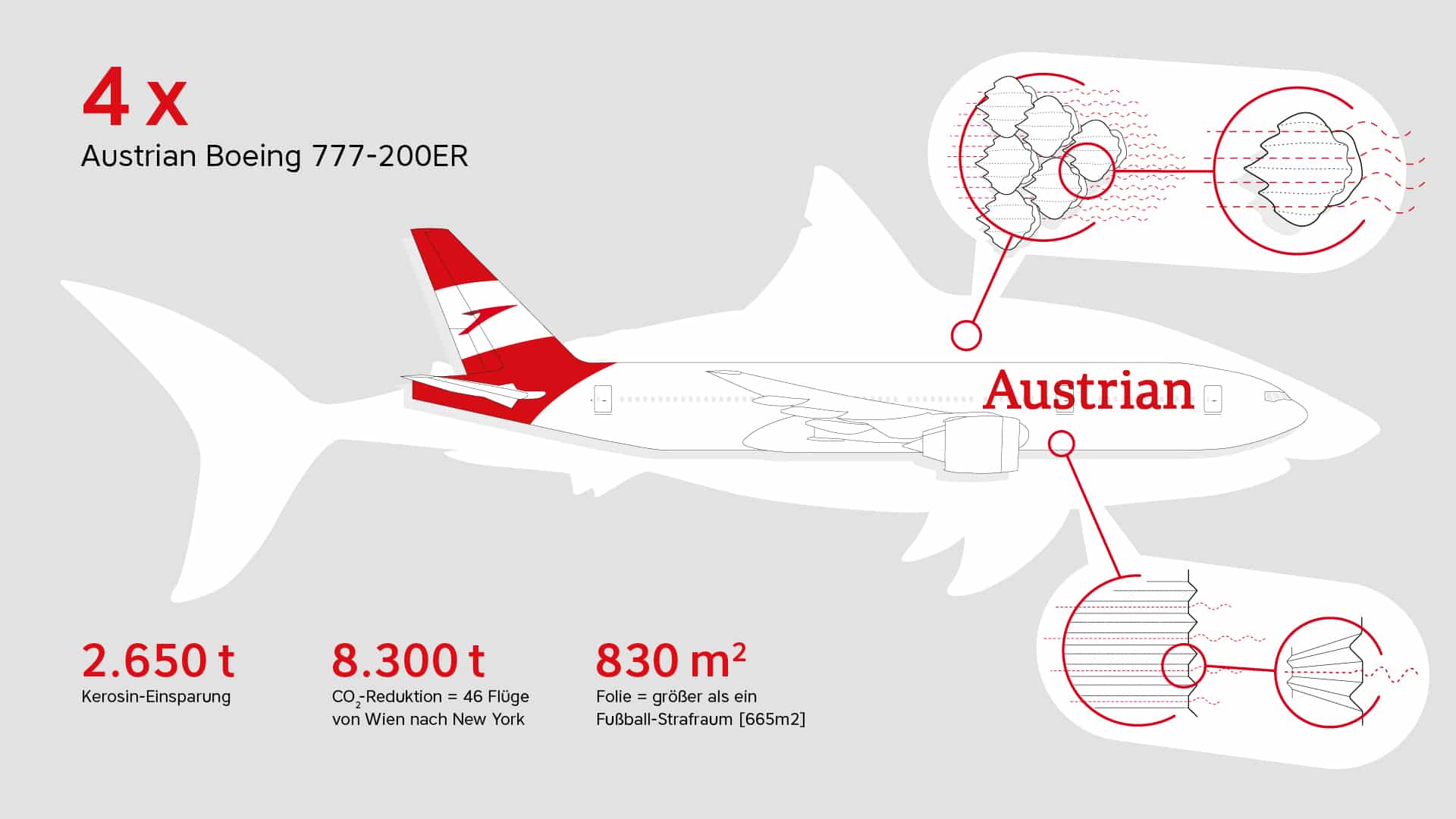
Together with Austrian Airlines, Lufthansa Technik is introducing the fuel-saving AeroSHARK surface film to another aircraft type. From winter 2024, four Boeing 777-200ER aircraft of the Austrian carrier 
will be equipped with the sharkskin technology. The riblet film reduces frictional resistance during flight and thus lowers the kerosene consumption as well as CO2 emissions of long-haul aircraft.

Four of Austrian Airlines’ six Boeing 777-200ERs will be sequentially modified with Lufthansa Technik’s AeroSHARK surface film as of December 2024. As a result, total savings of approximately 2,650 metric tons of fuel and over 8,300 metric tons of CO2 are expected over a service life of four years. This corresponds to around 46 flights from Vienna to New York.

“We take our responsibility seriously and take every possible step to reduce CO2 emissions within our flight operations. At one percent, the sharkskin’s efficiency potential may not sound like much, but in total it will save thousands of tons of CO2 per year on long-haul flights,” says Francesco Sciortino, chief operating officer at Austrian Airlines. “Even though our Boeing 777-200ERs are in their final years of service, we take this investment to get one step closer to our CO2 reduction targets.”

“The rollout of the fuel-saving sharkskin technology on another aircraft type with Austrian Airlines is great news for other Boeing 777-200ER operators as well,” emphasizes Harald Gloy, chief operating
officer at Lufthansa Technik. “These are the first of hopefully many more aircraft of this type that, thanks to AeroSHARK, will have lower kerosene consumption and an improved carbon footprint.”

AeroSHARK is a surface technology for aircraft developed by Lufthansa Technik and BASF that consists of riblets around 50 micrometers thick. It imitates the special structure of sharkskin, including its 
friction-reducing characteristics. This optimizes the aerodynamics in relevant areas of the aircraft, which reduces fuel consumption and cuts CO2 emissions. By applying around 830 square meters of the riblet film to the Boeing 777-200ER’s fuselage and engine nacelles, a saving of around one percent of the total fuel consumption per flight can be achieved.

A total of 17 Lufthansa Group aircraft have already been fitted with AeroSHARK – and the number is steadily increasing. The modified fleet includes a Boeing 747-400 of Lufthansa Airlines, 12 Boeing 777-300ERs of SWISS and four Boeing 777Fs of Lufthansa Cargo. The modification of the four Boeing 777-200ER aircraft operated by Austrian Airlines should be completed in March 2025.

XPENG AEROHT and GAMECO Enter Strategic Cooperation to Build After-Sales Maintenance System for Flying Cars

XPENG AEROHT, the largest flying car company in Asia, has entered into a strategic cooperation with Guangzhou Aircraft Maintenance Engineering Co. Ltd. (GAMECO), one of the leading aircraft maintenance, repair and overhaul (MRO) companies in the aviation industry. This cooperation will leverage XPENG AEROHT’s technological expertise in flying cars and GAMECO’s extensive experience in aircraft MRO, thereby establishing a robust after-sales maintenance system for flying cars that provides customers with reliable and convenient support.

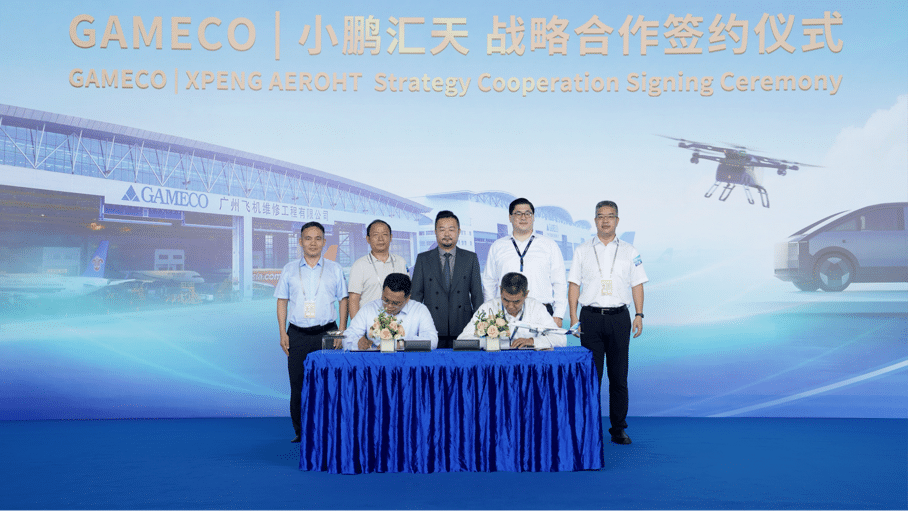
Witnessed by officials from the Civil Aviation Administration of China (CAAC) Central and Southern Regional Administration and the Guangzhou Aerotropolis Development District, XPENG AEROHT and GAMECO signed the Strategy Cooperation Agreement. Attendees also appreciated the XPENG AEROHT Traveler X2flying car on display in GAMECO’s hangar and had a tour at GAMECO’s advanced facility during the ceremony. 

Low-altitude flight is an innovative field with many standards yet to be established, and with GAMECO’s world-leading comprehensive MRO capabilities and experiences, this partnership will help XPENG AEROHTdevelop an after-sales maintenance system based on civil aviation safety management standards. 

Dr. Marc Szepan, general manager of GAMECO, stated that “Low-altitude travel represents an emerging sector in three-dimensional transportation. Combining the technological and data resources provided by XPENG AEROHT with GAMECO’s comprehensive maintenance expertise, I believe, will be driving high-quality growth in this industry together.”

Qiu Mingquan, vice president of XPENG AEROHT, commented, “Safety is our top priority, and we aim to deliver products that are both extremely safe and backed by exceptional service. GAMECO’s comprehensive technical capabilities and rich experiences will assist us in establishing a more professional continuingairworthiness management system, accelerating the commercialization of flying cars and bringing significant benefits to the industry and consumers.”

In March 2024, XPENG AEROHT received official acceptance of its Type Certificate (TC) application for its first flying car designed for individual consumers, known as the “Modular Flying Car or Land Aircraft Carrier,” by the CAAC Central and Southern Regional Administration. The strategic cooperation between XPENG AEROHT and GAMECO will prioritize the joint development of continuing airworthiness documentation to enhance safety for the product’s operation. Meanwhile, XPENG AEROHT will provide relevant data and technology support to position GAMECO in expanding its business in the low-altitude economy sector to achieve mutual benefits.

ATSG Delivers Boeing 767-300 Freighter to Euroavia Airlines

Air Transport Services Group announced that its subsidiary, Cargo Aircraft Management (CAM), has leased a Boeing 767-300 converted freighter to New York-based SLG Worldwide, who will sublease the aircraft to Euroavia Airlines, a cargo airline headquartered in Larnaca, Cyprus.

“SLG Worldwide is an experienced provider of logistics and aviation services around the world,” said Mike Berger, chief executive officer of ATSG. “Our leasing arrangement with SLG Worldwide in support of a new cargo airline exemplifies the attractiveness of our Lease+Plus package. We can support a new carrier with access to multiple services, including maintenance, ensuring timely delivery of additional capacity to the Eurasia markets.”

“We are thrilled to partner with ATSG to expand capacity with this Boeing 767-300 freighter,” stated Martin Zhu, chairman of Euroavia Airlines. “This addition will significantly enhance our ability to serve the growing demand in the Eurasia & Middle East region, providing reliable and efficient cargo services.”

“ATSG continues to develop and evolve global freighter capacity around the globe,” added Berger. “Our focus is on markets poised for growth where the economic data supports and validates our investment and is supported through partnerships with customers who are committed to delivering reliability and capacity to these regions.”

Senior Management Appointments at HAECO Airframe Services

The HAECO Group has announced a number of senior management changes at its Airframe Services division to enhance its commitment to providing customers with leading MRO services.

Following Jacqueline Jiang’s move within the Swire group to the role of chair, Chinese Mainland of John Swire & Sons (China), Ben Scheidel will succeed her and join the HAECO Group leadership team as group director, airframe services, effective 1st September 2024. In this role, Scheidel will have overall responsibility for the group’s airframe services activity globally.

With Scheidel moving into a HAECO Group role, Peter Murton will succeed him as chief executive officer of HAECO Hong Kong, and Derek Hui will take over as the new executive general manager, operations, overseeing base and line maintenance services in Hong Kong. Murton and Hui have broad experience in Airframe services, particularly within HAECO Hong Kong’s operations. Their new capacities will take effect on 1st September 2024.

Bill Collins, president of MRO Services, HAECO Americas, will retire from the HAECO Group at year-end. Todd Navin, the current chief financial officer at HAECO Americas, will succeed Collins effective January 2025. “Collins has led the business well during his tenure, guiding it through the Covid-19 pandemic and back to growth, supported by key airline partners,” a company release said. “The HAECO Group wishes him well in his next chapter and are confident that Mr. Navin will take the business forward in the years to come.”

“We greatly appreciate the longstanding trust and support of our valued partners,” said Richard Sell, HAECO Group chief executive officer. “Our new senior management team in Airframe Services will leverage their diverse talent and experience to build upon this successful collaboration and continue to work closely with our customers to ensure that we are addressing their MRO needs. We look forward to further strengthening these relationships in the years ahead as we continue to grow the HAECO group.”

Magnetic Training Adds A350 and B787 Training to Its Capability List

Magnetic Training, a sub-brand of Magnetic Group, announced that it has obtained EASA Part 147 approval to provide comprehensive training programs for the Airbus A350 and Boeing 787 aircraft. These new aircraft types will support Magnetic Training and its expansion in the widebody market. Until now, the company only provided widebody courses for A330 and B777. Moving forward, Magnetic Training will also offer A350 and B787 type trainings for B1 and B2, various difference (diff) and General Familiarization courses.

Magnetic Training’s enhanced capabilities further strengthen its positioning in the technical training market. In parallel, this approval supports the company’s growing presence in Asia. Based on the market demand, the current expansion of the training portfolio corresponds to the regional burgeoning of skilled aircraft maintenance personnel.

“Several key market trends influenced the decision to seek this approval. For example, increasing demand for A350 and B787 aircraft, particularly in Asia, where the concentration of these aircraft is highest, has underscored the need for qualified maintenance professionals. We see this as an opportunity to grow our presence in Europe and Asia, providing high-quality, EASA-approved Training,” says Natalja Platonova, chief of talents sector at Magnetic Group.

Magnetic Training is set to launch the new courses this autumn. It will offer open group sessions to individuals seeking to expand their skills. In addition, customized training schedules will be available for corporate clients, allowing companies to arrange sessions at a time and place that best fits their operational needs.

Boom Supersonic Accelerates Overture Aircraft and Engine Development

Boom Supersonic announced milestones across its Overture airliner and Symphony engine programs in July. Boom is reinventing the cockpit with an all-new flight deck, designed around pilots with safety at the forefront. Boom is making rapid progress on its Symphony engine, with hardware testing underway and the first full-scale engine core to be operational in just 18 months. Additionally, Boom announced that Symphony will be assembled in San Antonio, Texas through an expanded agreement with StandardAero.

Today’s announcements come on the heels of accelerating momentum for Boom. In March, the company conducted the historic first flight of its XB-1 supersonic demonstrator and in June completed construction on the Overture Superfactory in Greensboro, North Carolina.

“Passengers and airlines are hungry for supersonic flight,” said Blake Scholl, founder and CEO of Boom Supersonic. “Following XB-1’s successful test flight, we’re accelerating. Overture features an all-new flight deck, incorporating extensive pilot feedback, resulting in a flying experience that is both innovative and instantly familiar. Our Symphony engine has quickly progressed through design into hardware rig testing, and with a fully operational engine core on track for next year, our rapid development approach is pacing ahead of schedule.”

Boom continues to partner with airlines and best-in-class industry suppliers. Overture’s flight deck builds on the next-generation Honeywell Anthem avionics suite. An advanced head-worn vision system from Universal Avionics, who joins the Overture program today, is integrated into the flight deck. Boom worked with BAE Systems to integrate Active Control Sidesticks into the Overture flight deck simulator displayed at the Farnborough International Airshow.

Overture’s flight deck builds upon years of learning in aviation safety and is the result of extensive feedback from airline, business, and military pilots. Incorporating the Honeywell Anthem avionics suite, Overture offers pilots unprecedented situational awareness and ease of control, providing passengers with the safest possible flight experience.

Boom’s flight deck offers pilots the benefits of advanced automation and envelope protection, together with a force-feedback system that allows pilots to feel how the airplane is flying. With key airplane features accessible through high-definition touch screens, Overture can benefit from ongoing over-the-air software upgrades. Overture flight deck capabilities include:

  • Force-feedback sidesticks. For the first time on an airliner, force-feedback sidesticks allow pilots to control the plane while physically feeling both aircraft response and inputs made by the co-pilot or autopilot. 
  • Autoland and augmented reality. Building on the system flown on XB-1, Overture has an advanced augmented reality vision system for takeoff and landing, eliminating the need for the droop nose used on Concorde. Pilots can safely land using autoland or augmented reality views provided on a head-worn device and on the pilot’s primary flight display.
  • Large 17-inch touchscreens. High-definition touchscreens eliminate the hundreds of breakers and buttons found in legacy cockpits. Every airplane function is accessible through software while physical controls—such as stick, throttle, and landing gear—are offered for safety-critical functions.
  • Over-the-air upgrades. Overture will receive over-the-air software upgrades, meaning new features and improvements will arrive regularly. Airlines can control how upgrades are rolled out across fleets.

Boom recently completed a series of flight deck tests with commercial pilots from leading airlines, including Mike Bannister, former Chief Concorde Pilot for British Airways. 

“I’ve long believed that Overture is the rightful successor to Concorde,” said Mike Bannister, former Chief Concorde Pilot for British Airways. “After experiencing Overture’s flight deck, which is incredibly well designed and delightful to fly, my excitement and enthusiasm for this aircraft has only intensified.” 

Symphony engine advances to hardware testing; engine core to be operational in 18 months

Boom revealed in June that it is already building and rig-testing Symphony hardware, starting with a full-scale test of combustor aerodynamics. The first 3D-printed parts have been produced for Symphony, including fuel nozzles and turbine center frames. 

These hardware tests began just 18 months after the initial announcement of Symphony, demonstrating Boom’s rapid development approach. As part of this strategy, the company will conduct more than 30 engine hardware rig tests, allowing for validation and optimization of all key engine components, ranging from fan and nozzle acoustics to combustor fuel efficiency.

Boom also announced that it has accelerated development of a full-scale engine core, which will be operational in late 2025. Engine core testing will analyze performance of the compressor, combustor, and turbine section. Data gathered will further refine engineering and expedite production of a fully certified engine. Following this rapid development approach, Boom expects to build and test multiple iterations before certifying the final refined engine.

Boom also expanded its existing MRO partnership with StandardAero to include the production of Symphony. StandardAero will assemble and test Symphony engines at its facility in San Antonio, Texas. The Symphony assembly line will scale to produce 330 engines annually within a footprint projected to total over 100,000 square feet of production space.

“We are excited to expand our role to include the assembly and testing of Symphony engines, further supporting the development of next-generation flight with Boom,” said Russell Ford, Chairman and CEO of StandardAero. “Our collaboration is a testament to StandardAero’s world-class engineering capabilities and dedication to delivering solutions that power the future of air travel.”

Additionally, Boom announced it is teaming with aerospace leader ATI, Inc. for advanced high-temperature materials and components for Symphony’s high pressure compressor integrated blade and disk stages and for its turbine assembly. These advanced nickel-based superalloys will enable Symphony to achieve high performance and reliability in sustained supersonic operation.

Overture remains on target to achieve FAA and EASA certification by the end of the decade.

RobotLAB Brings Wide-Ranging Robotics Integration Services to Knoxville

RobotLAB is expanding its robotics solutions to Knoxville, Tennessee, headed by local aviation expert and veteran Mike McLaughlin. Launched in 2023 to meet the growing demand for AI and robotics business solutions, RobotLAB’s nationwide expansion initiative will increase access to automation and operational efficiency solutions like cleaning, delivery and customer service robots throughout Knoxville, allowing businesses of all sizes to implement cost-saving robot technologies. In addition to Knoxville, RobotLAB has numerous locations in the pipeline in Colorado, Florida, Nevada and Texas, underscoring the growing demand for innovative robotic technologies in key economies across the U.S.

“Knoxville is rapidly becoming one of the South’s leading entrepreneurial and innovation hubs, and business owners, employees and locals all stand to benefit from a robot’s ability to reduce inefficiency, perform menial tasks and enhance the customer experience,” said Elad Inbar, founder and CEO of RobotLAB. “Mike’s aviation experience and local ties will be valuable assets in introducing RobotLAB Knoxville’s expansive robotics catalog to the diverse and innovative community.”

McLaughlin brings years of experience as a U.S. Navy helicopter instructor pilot and Aviation Facilities Compliance Officer, boasting maintenance and operations expertise that will be crucial to RobotLAB’s expansion into Tennessee. The new location will allow McLaughlin and his team to seamlessly deliver to Knoxville-area businesses RobotLAB’s best-in-class services, including sales, tailored programming, onsite integration and repairs. Local owners preferring to test the robots in their businesses before fully integrating will have the opportunity to do so. By establishing an expansive, reliable network of robot specialists across the U.S., RobotLAB is forging a future where business owners have local access to the world’s most comprehensive robotics portfolio, offering cost-effective and labor-saving solutions for companies in all sectors.

“The University of Tennessee and Oak Ridge National Laboratory attract vibrant, clever minds to Knoxville, many of whom are responsible for the city’s innovations and future-focused thinking,” said McLaughlin. “I’m honored to facilitate RobotLAB’s joining of forces with Knoxville’s warm, welcoming and imaginative community, and look forward to integrating valuable robotics solutions that will improve the lives of business owners, employees and customers.”

With an impressive roster of longstanding partnerships spanning the world’s top robot manufacturers and more than 10,000 robots deployed across the globe, RobotLAB is proud to share 15+ years of expertise with its local offices and the communities they serve. Aiming to increase access to robotics and AI solutions across the U.S., RobotLAB’s revolutionary nationwide expansion allows local branch presidents like McLaughlin to seamlessly introduce businesses in their area to the power of automation. RobotLAB’s franchise program boasts minimal overhead, comprehensive online and in-person training, limited staffing requirements and attractive revenue opportunities in a fast-growing industry with limitless potential. Plus, the program’s low cost of entry and thorough training module make it ideal for entrepreneurs looking to enter the franchising world, as well as experienced franchisees seeking portfolio diversification with a first-of-its-kind opportunity.

RobotLAB’s suite of solutions includes cleaning, delivery, customer service and security robots for businesses of all sizes. Its unique program offers customers an online learning system to master the robots, accessible standard operating procedures, on-site training and installation and service plans for local repair and other technical needs. With thousands of current customers and an expanding local presence across the country, the company is positioned to be the car dealership of robotics with the ability to sell, service, repair and offer consumables in one local suite accessible to all major U.S. urban centers and commerce hubs.

Lufthansa Technik to Support Austrian Airlines’ 787 fleet

As with Lufthansa Airlines’ Dreamliners, Lufthansa Technik AG will also take over the long-term component supply for Austrian Airlines’ Boeing 787 fleet, which is currently being built up. In a recently 
signed contract, the two companies have agreed on Total Component Support (TCS) for up to eleven long-haul aircraft until the end of 2032.

In addition to the classic MRO (maintenance, repair and overhaul) of aircraft parts, TCS includes the so-called open-loop component supply from Lufthansa Technik’s global parts pool. If Austrian reports a 
defective component in one of its 787s, the airline does not have to wait for it to be repaired, but receives a ready-to-use replacement part from the Lufthansa Technik pool immediately and as quickly as possible — worldwide. Downtimes of the affected aircraft caused by the parts defect can thus be reduced to a minimum.

Lufthansa Technik has been providing the first services under the new787 contract since June of this year and is gradually building up a stock of materials for the Dreamliners stationed in Vienna. The TCS 
is tailored to the needs of the Austrian Airlines 787-9 fleet, which is initially being built up with seven used aircraft and will later be supplemented by currently four factory-new aircraft.

“We have had good experience with TCS for our A320 and 777 fleets for many years,” said Stephan Koenen, senior director engineering & commercial at Austrian Airlines. “Expanding the range of services to include the Boeing 787 was therefore a logical consequence. With this contract, we are creating a high level of supply security for this aircraft type with an optimized cost position.”

“Due to its large quantities and global deployment, the Boeing 787 is an aircraft type where our Total Component Support can fully play to its strengths,” explained Kai-Stefan Röpke, vice president corporate sales Europe, Middle East and Africa at Lufthansa Technik. “Thanks to our large pool of spare parts, we are able to provide Austrian with the right Dreamliner spare part immediately. And with our 15 parts warehouses around the world, the required component is often just a stone’s throw away. This gives Austrian Airlines the best possible component supply for its new Dreamliner fleet.”