Boeing Delivers B-52 with New Radar to U.S. Air Force for Testing

Boeing has delivered the first B-52 Radar Modernization Program (RMP) flight test aircraft to the U.S. Air Force for testing with the 412th Test Wing at Edwards Air Force Base in California. The test aircraft was fitted with an APQ-188 active electronically scanned array radar system that is akin to those on fighter aircraft. 

The RMP upgrades are a critical part of the B-52’s broader modernization efforts that will keep U.S. global strike capability ahead of threats through 2050 and beyond. The testing at Edwards AFB follows ground integration and initial system functional checks completed at Boeing’s San Antonio facility. 

“The new radar will significantly increase B-52 mission effectiveness by improving situational awareness, speeding target prosecution and enhancing aircrew survivability in contested environments,” said Troy Dawson, vice president of Boeing Bombers. “This phase of the program is dedicated to getting it right at the start so that we can execute the full radar modernization program.”

Data gathered during testing will inform subsequent developmental test phases and the planned retrofit of the 76 operational B‑52 aircraft.

RMP also includes two Display and System Sensor Processors as its mission computers to integrate the radar with B-52 systems, along with two large 8×20-inch high-definition touchscreens at the Nav and Radar Nav stations for radar imagery, control and legacy displays, and two fighter-like hand controllers for radar operation. The system features upgraded cooling, providing liquid cooling for the radar and engine bleed-air heating for very cold conditions. 

Malaysia Selects Aireon’s Space-Based ADS-Bfor Surveillance in Oceanic Airspace

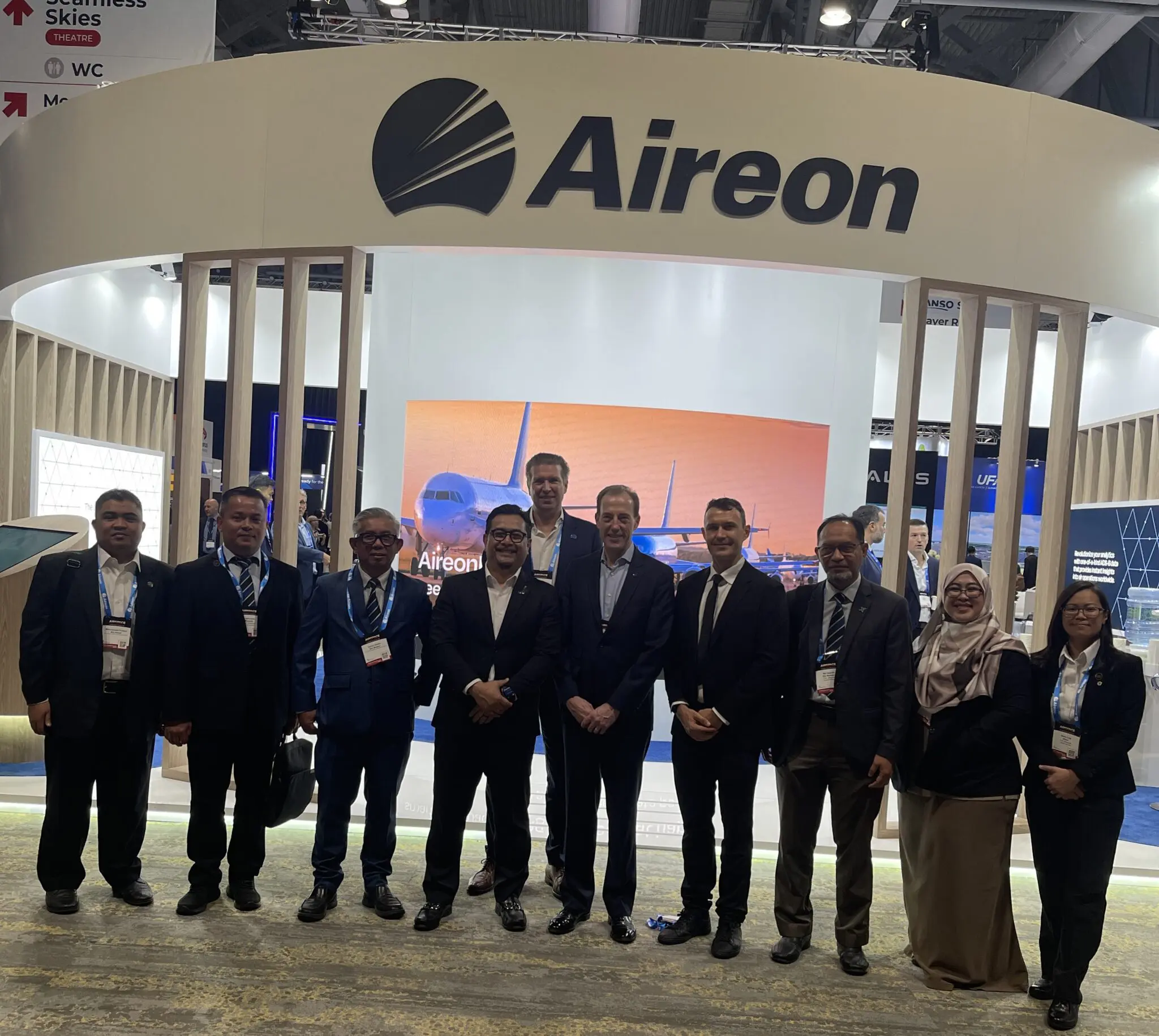
The Civil Aviation Authority of Malaysia (CAAM) and Aireon have announced a strategic collaboration to deploy Aireon’s space-based Automatic Dependent Surveillance–Broadcast (ADS-B) data for air traffic surveillance across the oceanic sector of the Kuala Lumpur Flight Information Region (FIR). This initiative marks a major milestone in strengthening Malaysia’s air traffic management capabilities and enhancing operational safety and efficiency across one of the world’s busiest international air corridors.

Aireon, in partnership with its local partner ClearWisdom, signed the agreement at this week’s Airspace
Asia Pacific event in Hong Kong. The agreement includes Aireon’s EASA-certified space-based ADS-B
data covering the oceanic service volume of the Kuala Lumpur FIR West Region. This includes a substantial portion of the Bay of Bengal and Andaman Sea, a critical corridor for flights connecting Asia and the Middle East.

Malaysia plays a pivotal role in the safe management of this region, surrounded by Jakarta FIR (Indonesia) to the south, Chennai FIR (India) to the west, and Singapore FIR to the east. Several regional air navigation service providers (ANSPs) including the Airports Authority of India and the Civil Aviation Authority of the Philippines have already adopted Aireon’s data services, contributing to greater interoperability and regional cooperation.

“Thank you to CAAM for entrusting Aireon to bring space-based ADS-B data to Malaysia,” said Peter
Cabooter, Aireon executive vice president of customer affairs. “Air traffic in the region is poised to grow
strongly in the coming years, and Malaysia is responding strongly by investing in safety for the airspace.”

“The implementation of Aireon’s space-based ADS-B service represents a key milestone in strengthening Malaysia’s air traffic surveillance capabilities, particularly over the Bay of Bengal and Andaman Sea. This enhancement will support safer, more efficient airspace operations and aligns with CAAM’s continuous efforts to modernize Malaysia’s air traffic management system and advance regional collaboration,” said Dato’ Captain Norazman Bin Mahmud, CEO of CAAM.

The integration of space-based ADS-B forms part of CAAM’s long-term plan to modernise surveillance
infrastructure and improve situational awareness in remote and oceanic airspace where ground-based
radar is limited. This collaboration will support Malaysia’s commitments under ICAO’s Global Air Navigation Plan (GANP), enabling enhanced safety, reduced separation standards, more efficient routing, and improved environmental outcomes.

KNIPEX Tools Awarded Chicago’s 2025 Best & Brightest Companies to Work For

KNIPEX Tools was recognized as one of Chicago’s Best & Brightest Companies to Work For, a distinction awarded by the National Association for Business Resources. The award celebrates organizations that prioritize their workplace culture and continue to raise the bar as leaders in employment standards.

With 25 years of experience conducting the Best and Brightest competitions, the National
Association for Business Resources (NABR) partners with an independent research firm to review several key metrics before selecting winning companies. The categories for scoring include: Compensation, Benefits, and Employee Solutions; Creative Wellness and Wellbeing Solutions; Employee Enrichment, Engagement, and Retention; Employee Education and Development; Recruitment and Selection; Employee Achievement and Recognition; Communication and Shared Vision; Civility and Inclusion; Work-Life Blend; Community Initiatives and Corporate Responsibility; and Leadership, Strategy, and Company Performance.

Six years ago, KNIPEX Tools LP (KTLP) launched a values-based culture for its employees with four core values: Knowledge, Teamwork, Loyalty and Passion. The values have become the building blocks for how the company does business, informing everything from people
strategies, benefits, training, performance reviews and more.

The award comes just on the heels of KNIPEX Tools being Certified by Great Place To Work
for the second consecutive year.

“We are very proud of the culture we have built – one based on respect, support,
communication, and especially, our shared values.” Julie Day, vice president of human
resources, expressed when asked what the latest accolade means to the organization. She
continued, “The experience we create internally directly influences company performance.
When our employees feel valued and love what they do, they contribute at the highest levels.
Receiving this additional recognition helps those outside the company see what we already
know to be true — that KTLP is a great company to work for.”

Rautenstrauch Named President and CEO of Textron Specialized Vehicles Inc.; Scholl to Assume New Role as Bell CCO

Textron announced that Jörg Rautenstrauch has been named president and CEO of Textron Specialized Vehicles Inc., effective January 4, 2026. Rautenstrauch will continue to serve in his role as president and CEO of Kautex and the Textron Industrial segment.

Rautenstrauch will succeed Rob Scholl, who has been named chief commercial officer of Bell to replace Danny Maldonado who, as previously announced, was appointed as Bell’s president and CEO, effective January 4, 2026.

Rautenstrauch joined Textron in 2011. He was named president and CEO of Kautex in 2016, and in 2020, was appointed president and CEO of the Textron Industrial segment.

“Jörg has been an outstanding leader for Kautex and possesses a deep understanding of our TSV business,” said Scott C. Donnelly, Textron chairman and CEO. “His leadership will allow us to effectively execute on our business plans and meet the demands of our customers.”

In joining Bell as chief commercial officer, Scholl brings more than 19 years of experience across Textron businesses. Since 2023, he has led Textron Specialized Vehicles and, prior to this role, built Textron eAviation as a business segment as president and CEO. At Textron Aviation, Scholl held a series of senior sales and marketing roles, including senior vice president, Global Sales & Flight Operations; vice president, Parts & Programs; and vice president, Marketing.

Commenting on Scholl’s appointment, Lisa Atherton, Bell president and CEO and the incoming Textron president and CEO as of January 4, 2026, said, “We are thrilled to welcome Rob to Bell as our new chief commercial officer. Rob is a respected leader across the Aviation industry and Textron and he is well positioned to continue achieving success across our commercial sales, aftermarket and customer service programs.”

Boeing Contracts Lufthansa Technik Defense for Sustainment of German Navy’s P-8A Poseidon

Boeing and Lufthansa Technik Defense signed a multi-year contract on comprehensive technical
sustainment services for the growing fleet of the German Navy’s eight P-8A Poseidon maritime patrol
aircraft, the first of which was delivered earlier this month. The agreed work scope will include nearly all
product segments of the global Maintenance, Repair and Overhaul (MRO) company, from aircraft
maintenance and engine support services via component supply to operations management and technical training. The several decades of experience in maintaining the Boeing 737 – the technical basis for the P-8A Poseidon – allows Lufthansa Technik to support the German Navy with a nearly unrivalled expertise for this aircraft type.

“This new contract expands our military MRO portfolio to include its first weapon-bearing aircraft system and further strengthens its long-standing and trusted partnership with the German Armed Forces,” said Michael von Puttkamer, vice president special aircraft services & defense at Lufthansa Technik. “The company plays a vital role in ensuring the operational readiness of this new weapon system and, in the spirit of Germany’s “Zeitenwende” [turning point] in security policy, contributes to the strengthening of national defense capabilities.”

Lufthansa Technik will provide the Navy with comprehensive Aircraft Maintenance Services right from the start of the German P-8A operations. The company’s headquarters in Hamburg will become a mainstay for both Line Maintenance (in-service checks) and Base Maintenance Services (heavy airframe and system checks) on the Poseidon. With this agreement, Germany is Lufthansa Technik Defense’s third P-8 customer, after New Zealand and India.

To ensure the reliable supply of spare parts, even in times of challenged global supply chains, Lufthansa
Technik will support the German Navy’s P-8A operations from its Aircraft Component Services segment. The company’s Total Component Support provides the Navy with access to Lufthansa Technik’s dedicated pool of P-8 commercial spare parts. Open-loop exchanges with Lufthansa Technik enable the Navy to directly replace any unserviceable aircraft components without waiting for repairs. This reduces spare-part related aircraft downtimes to a minimum and significantly increases the operational readiness of the German Poseidon fleet.

In addition, Lufthansa Technik will ensure the constant supply of Consumables and Expendables, such as bearings, fasteners or lubricants. To maximize both efficiency and time-on-wing of the P-8A’s engines, especially in their usually rough operating environment flying over salt water, Lufthansa Technik will also conduct a dedicated Engine

SKF Presents a Novel Bearing Steel Designed to Enable the Next Generation of Eeroengine Technology

SKF says it is re-imagining intelligent and clean rotation with the development of an innovative temperature-resistant, corrosion-tolerant steel for aeroengine bearings called ARCTIC15.

With the Aerospace industry striving to reach net zero emissions by 2050, next generation jet engine designs are evolving toward architectures which require rolling bearings capable of higher power density and speeds beyond the current design rules.

SKF’s customers are designing new engines that aim to cut fuel use by 20 to 25%*, which also reduces emissions. To support these new designs, SKF says its new steel will enable bearing solutions that can support the development of new architectures of engines for aviation.

“As aviation moves toward designing engines that aim to cut fuel consumption by up to 25%, reducing emissions significantly, SKF is innovating to match that ambition. Our new steel alloy ARCTIC15 is engineered as a breakthrough material to allow for smaller, more compact bearing solutions that handle higher loads, unlocking new engine architectures and driving efficiency across the entire lifecycle, with repairability as a key driver. This novel steel enables faster development cycles and supports industry sustainability goals for the future,” said Gregory A Zimmerman, director of aerospace business unit at SKF. 

For such performance increase, the first step is made by replacing steel rolling elements with ceramic rolling elements. The second step comes by pairing ceramic rolling elements with an advanced aeroengine bearing steel with higher load and temperature capacity than existing steels. These distinctive properties open the door to new engine architectures with enhanced efficiency.

“With cross-functional collaboration and sustainability-driven programs aligned with global mega-trends and industry needs, we are actively driving the climate transition. As both a supplier and customer, we transform deep insights into smart, practical solutions that reduce friction, cut emissions, and extend equipment life—helping industries move toward more sustainable operations,” says Hans Landin, president, specialized industrial solutions.

The new patented steel technology will be commercially available and shared by SKF at the Patent Bay. A new platform open to companies that aim to accelerate technologies with the potential to advance sustainability, by making selected patents freely available to others. 

The following sparked the developmentof ARCTIC15

  • SKFs Aerospace team has been developing and successfully testing an innovative case-carburized stainless steel for aero-engine bearings for nearly a decade, ever since SKF’s customers began designing next-generation engines focused on reducing fuel consumption — driven by the EU-funded Clean Sky initiative

HEAVEN | Clean Aviation

  • Extensive material and tribological testing, ranging from elemental analysis to full-scale trials, has validated the performance capabilities of the developed bearing material technologies
  • SKF Aerospace factories have manufactured demonstrator and full-scale bearing prototypes combining this advanced steel with ceramic balls, validating their endurance and resistance to severe operating conditions — including scenarios where oil supply is discontinued.
  • An actual ground test demonstration will be performed early 2026 as part of the Technology Readiness Levels process with one of the industry’s leading aeroengine original equipment manufacturers (OEM).

Former StandardAero Regional Sales Manager Steve Lunde Receives Charles Taylor Master Mechanic Award

Steve Lunde, former regional sales manager for the Western U.S. on the business aviation team at StandardAero was awarded the Federal Aviation Administration’s (FAA) Charles Taylor Master Mechanic Award earlier this year. The award was presented on June 17, 2025, during a ceremony held at StandardAero’s Van Nuys, California facility, surrounded by friends, family and colleagues from across the country.

The prestigious recognition commemorates Lunde’s remarkable achievement of maintaining an Airframe & Powerplant (A&P) License for more than 50 years — reflecting his lifelong passion, technical expertise and exceptional service within the aviation industry. After decades of meaningful contributions to StandardAero and the business aviation community, Lunde has since retired from his role but remains actively involved.

“I have now been an A&P Technician for over 50 years. What a great ride. I’ve worked on everything from a C-150 to a Boeing BBJ. I can’t tell you how rewarding it has been. What a great industry we work in,” Lunde said.

Lunde’s passion for aviation began at just four years old, inspired by childhood summer trips to Hawaii. This early fascination developed into a dynamic career after he earned his A&P License in 1975, working on 737s and C130s.

He later advanced to the role of director of sales at Gulfstream Aerospace, where he was directly involved in former Gulfstream owner Allen Paulson’s world record-setting G400 project. His career ultimately led him to Dallas Airmotive, which later became StandardAero, where he carved out a legacy as a trusted leader and friend. In his most recent role, Lunde served as regional sales manager within StandardAero’s Rolls-Royce Engine Program, embodying true dedication to both customer success and industry excellence, StandardAero said.

“It’s everything. It’s what my whole life has been,” he said when asked about the meaning of receiving the Charles Taylor Award.

Reflecting on Steve’s decades-long impact, Michael McCauley, senior director of the Rolls-Royce program at StandardAero, shared: “The Charles Taylor Award is a great example of Steve’s dedication to the industry… for over five decades. You don’t have the knowledge that Steve has and share the knowledge that Steve has without the character and respect of others to do so.”

“Congratulations once again to Steve on earning this esteemed recognition and for an incredible career in aviation—one that we are grateful to continue supporting through his new role as a customer,” the company said in a press release.

StandardAero Delivers 1,000th J85-5 Engine to U.S. Air Force

StandardAero announced the delivery of its 1,000th GE Aerospace J85-5 engine to the United States Air Force (USAF), marking a significant milestone in support of the T-38 Talon trainer aircraft fleet.

This achievement comes just five years after StandardAero commenced work under the multi-year Engine Regional Repair Center contract with the USAF. The J85-5 engine powers the T-38 Talon, a critical platform used to train fighter pilots for the USAF and allied nations. The J85-5 engine is one of several platforms on which StandardAero delivers comprehensive MRO solutions supporting mission-critical operations for government and military customers worldwide.

The J85 was originally designed in 1954 and is expected to power U.S. Military aircraft until 2040 and beyond. In addition to the T-38 Talon, the powerplant has been used for diverse military applications spanning the GAM-72 Green Quail missile decoy installed in the Boeing B-52 bomber, and the N156F Freedom Fighter (designated the F-5). The J85-powered F-5 has become a successful aircraft globally. In addition, the CJ610 is a commercial variant of the J85 that powered the Lear Jet launched in 1963.

To commemorate the 1,000th engine delivery milestone, StandardAero hosted a ceremony at the Tech Port Center in Port San Antonio, led by J85-5 Program Manager Greg “Chappy” Chapman. The event was attended by members of the J85-5 production team, support organizations, and distinguished guests.

“Supporting the USAF pilot training mission is a tremendous honor,” said Rick Pataky, vice president and General Manager of StandardAero’s Military Division in San Antonio. “Delivering 1,000 engines in such a short timeframe is a testament to the dedication and collaboration of our entire team.”

Marc Drobny, president of StandardAero’s military, helicopter, and energy division added: “This milestone reflects the strength of our partnership with the USAF Propulsion Program Office, Air Education and Training Command, and the 448th Supply Chain Management Wing. Together, we’ve built a resilient and transparent value chain that supports the entire J85-5 fleet, flight line and national security.”

All J85-5 engines are serviced exclusively at StandardAero’s Port San Antonio facility, which spans more than 810,000 square feet and supports five major engine MRO programs for both military and commercial customers. The site also hosts StandardAero’s Aviation Mechanic Training Program, which trains over 200 mechanics annually. StandardAero’s Stockton, Calif., location services all other J85 engine variants, and it has been providing J85 accessories and component repair to the USAF J85 Management of Items Subject to Repair (MISTR) system since 2013. Additionally, the Stockton site provides J85-21 support to the United States Navy and to countries in the Foreign Military Sales (FMS) program.

In addition to its military programs, StandardAero also provides support for the next-generation CFM International LEAP-1A and LEAP-1B engine as a CFM LEAP Premier MRO provider from its San Antonio facility. The site began accepting LEAP-1A and LEAP-1B engine inductions in March 2024 and has since accelerated its ramp-up to full operational scale, supporting global operators with enhanced throughput and efficiency.

Bally Ribbon Mills Highlights Advanced Webbing Solutions for the Parachute Industry

Bally Ribbon Mills (BRM) is highlighting its advanced webbing solutions for the parachute industry. With a longstanding reputation for quality and innovation, BRM’s webbing is designed to meet the critical demands of aerospace and commercial parachute applications, ensuring optimal performance, strength, and durability.

BRM’s parachute webbing is engineered using high-performance fibers such as Nylon, Kevlar, Vectran, PTFE, and Zylon PBO, providing superior strength, strength to weight ratio and reliability. Manufactured to meet stringent military specifications, including PIA-Spec and Mil-Spec standards, these narrow woven fabrics are essential components in life-support systems. The company’s Nylon Webbing (Mil-W-4088K) and Tubular Nylon Webbing (Mil-W-5625K) are Berry Amendment compliant and undergo rigorous testing to meet the exacting standards required for critical parachute applications.

BRM is developing new woven tapes and webbings utilizing DuPont’s Kevlar EXO, a next-generation fiber that offers a higher strength-to-weight ratio compared to Kevlar 29 and Vectran. This material provides enhanced performance characteristics while maintaining a more competitive price point than traditional PBO materials. Currently under evaluation for use in the parachute industry, Kevlar EXO presents a promising alternative for applications requiring lightweight strength and reliability.
Designed to withstand extreme conditions, BRM’s parachute webbing features low pack volume, high energy absorption, and superior abrasion resistance, making it ideal for deployment in demanding environments. These materials are integral to parachute canopy reinforcements, harnesses, and risers, ensuring both safety and reliability in airborne operations. Beyond traditional parachute systems, BRM’s webbing solutions support advanced aerospace applications, including space rocket launch vehicles, capsule recovery programs, and NASA-directed commercial sector initiatives.

BRM maintains the highest quality standards, holding ISO 9001:2015 and AS9100D certifications, underscoring its commitment to precision and excellence. The company ensures strict compliance with federal regulations, providing Berry Amendment-compliant products that are 100 percent sourced and manufactured in the United States. This dedication to quality and reliability has solidified BRM’s reputation as a trusted supplier of high-performance webbing for mission-critical applications.

US Navy Bringing ‘Fat Albert’ Back to Marshall Aerospace for New Center Wing Box


Fat Albert, the world’s most recognizable C-130 Hercules, will soon return to Marshall Aerospace’s hangars for crucial structural work that will add decades to its lifespan. The iconic support aircraft for the US Navy’s Blue Angels flight demonstration squadron is scheduled to arrive in Cambridge, UK, later this year for a center wing box replacement — a complex engineering procedure akin to spinal surgery.

Payload Meets Performance
Fat Albert is considered the global standard-bearer for the capabilities and design philosophy of the C-
130 Hercules, embodying the versatility and reliability of the most successful military airlifter in history.
As the logistical workhorse that makes the Blue Angels’ busy airshow schedule possible, Fat Albert covers over 100,000 miles each season as it transports up to 45 personnel and a range of specialized equipment back and forth across the United States.

Fat Albert is also a performer in its own right, kicking off each Blue Angels show with a 15 minute
demonstration of remarkable athleticism, earning fan-favorite status for a range of stunts including high- speed low-altitude passes, steep climbs, sharp banks and combat landings. It is currently the only C-130 to perform regularly in demonstration flying displays.

This constant routine of marathons and gymnastics takes a unique toll, resulting in elevated stress and
fatigue on Fat Albert’s airframe over the years. From a lifecycle management perspective, this requires an unusual degree of expert care and maintenance planning by its operator, the US Navy.

Live Fast, Die Old
Fat Albert’s center wing box is an example of a “lifed article” — a critical component with a finite
operational lifespan in terms of total flight hours or years in service. As the major primary structure that connects the aircraft’s outer wings to its fuselage, the center wing box bears significant operational load and sustains exceptional stress during flight. Once it has reached its end of life, it will need to be replaced in order for the aircraft to remain airworthy. If this does not happen, the
aircraft will be grounded.

Installing a new enhanced service life center wing box from Lockheed Martin is a highly cost-effective
way to extend Fat Albert’s useful lifespan by more than 20 years. However, this is not a simple process involving swapping out an 11-meter section of wing primary structure for a new section: it is the aerospace equivalent of invasive spinal surgery, and can only be carried out by
a team with extensive engineering capability and specialist equipment.

Marshall has completed 80 center wing box replacements on both legacy C-130 models and the current production model C-130J Super Hercules, extending the collective lifespans of these aircraft by at least 1,600 years. In 2024, Lockheed Martin named Marshall the world’s first authorized Center of Excellence for C-130 center wing box replacements.

In addition to center wing box replacement, Fat Albert will undergo routine maintenance at Marshall,
including a full paint strip and repaint in the highly distinctive Blue Angels livery.

“Fat Albert’s return to Cambridge will be a moment to celebrate for the entire Marshall Aerospace
team. We are grateful to the US Navy for trusting us once more with such a valuable asset, and are pleased to undertake this expert work as one of a small handful of center wing specialists.” said Chris Dare, director, MRO services and solutions, Marshall Aerospace.

British Backstory
Fat Albert isn’t just an iconic C-130: it has close ties to the UK and Marshall in particular. Like every C-130J Super Hercules, the airframe started life on Lockheed Martin’s production line in Marietta, Georgia. After crossing the Atlantic for the first time, it arrived in Cambridge to be prepared by Marshall for entry into service with the Royal Air Force (RAF).

Between 2001 and 2017, Fat Albert flew under the tail number ZH885 for the RAF’s 24 Squadron, and
returned to Marshall frequently for maintenance and engineering work during this period. In 2019, the US Navy acquired the aircraft from the RAF as a replacement for its previous Fat Albert, an older C-130T model. Marshall was awarded the support contract for maintenance, paint and modifications ahead of entry into service with the Blue Angels.

Fat Albert crossed the pond again upon completion of work by Marshall in 2020, relocating to the Blue
Angels’ operating base in Pensacola, Florida — just a few hundred miles away from its place of
manufacture.